🌟March Theme: Fellowship🌟
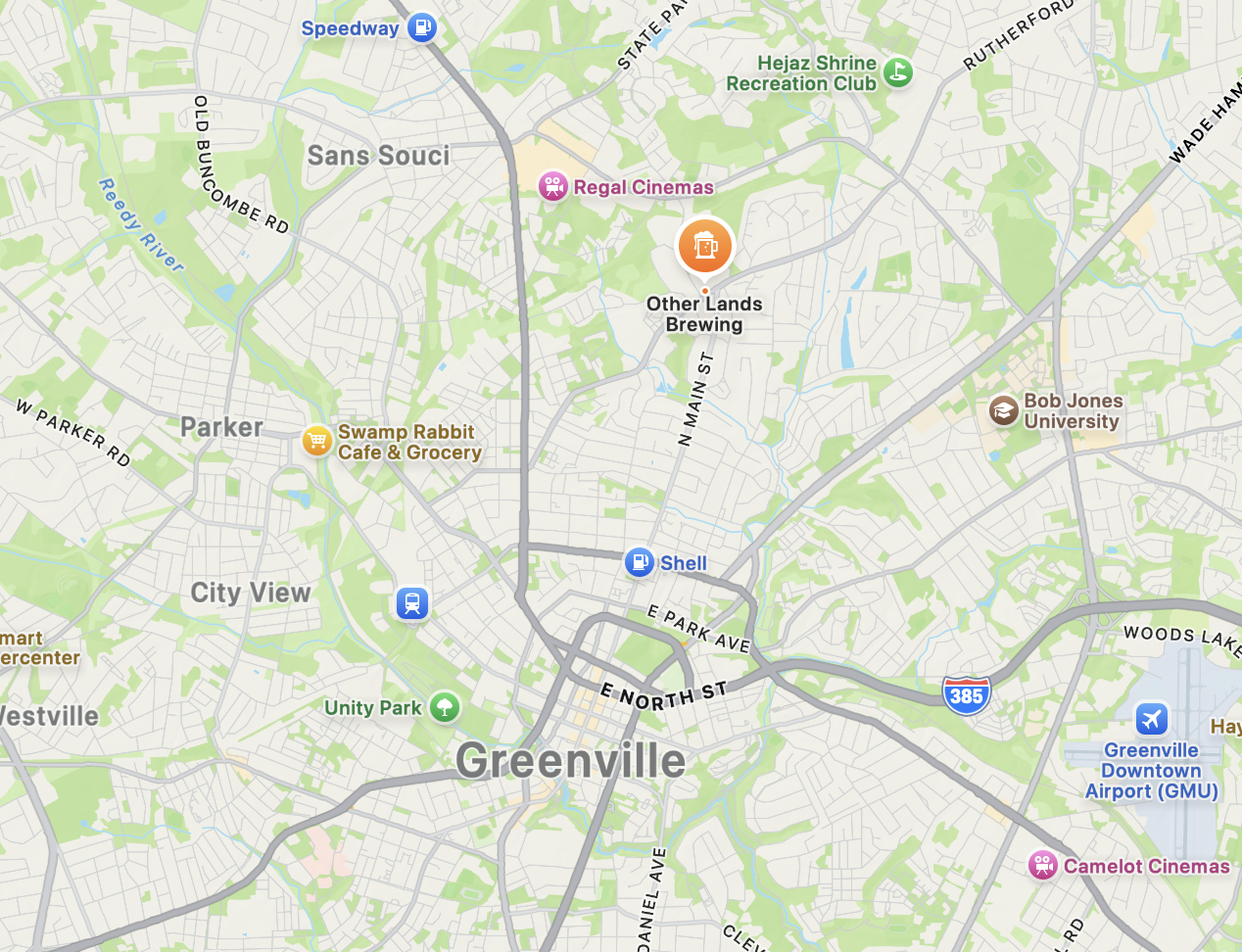
🌟Worship at Other Lands🌟
🌟Sunday, March 15 starting at 10:30 a.m.🌟
During our monthly worship service, we continue our look at fellowship in a way that stretches how we think about community and whose voices shape the church.
Learn about Feminist Theologies: During our Divine Discoveries time, we will look at the waves of feminist theology and how women theologians have challenged the church to expand who is heard, valued, and trusted in shaping our faith. Their work reminds us that fellowship is not simply gathering together. It is creating a community where voices that have been overlooked or silenced are welcomed and where wisdom is shared more widely across the body of Christ.
Our worship music will echo that theme. The praise team will lead “Remind Me Who I Am,” which includes the powerful line, “I’m the one you love.” In a world that often tells people they do not belong, the gospel keeps reminding us that our identity begins with being loved by God. For special music, our Praise Team will share “Fearless,” a song that calls us to live with courage and trust. Expanding who is heard in the church often requires that kind of courage, both from those who speak and from communities willing to listen in new ways.
Our usual sermon time will take a different form this month. Instead of a traditional message, we will present a short dramatic piece titled “Guest List Interrupted.” Brian, Tracy, and Laura will bring the story to life as we imagine the tension around who belongs at the table and who gets to decide. Through the lens of the story in Luke 7, the play invites us to reflect on hospitality, power, and the surprising ways fellowship can disrupt our assumptions.
Finally, “All the People Said Amen” celebrates the shared voice of the whole community, declaring that faith is not the possession of a few but something expressed together. The chorus reminds us that praise rises from the many, not just the few.
It should be a thoughtful and engaging morning as we explore what it means for the church to widen the circle and practice a deeper kind of fellowship together.
Dear Beloved Community,
Whose Voices Shape Our Faith?
We think that Christianity, the Bible, God, and faith never change, but every generation and in fact each person inherits a unique theological tradition. Organized religions pass down important scripture, interpretation, and centuries of reflection about God, humanity, and the life of faith. Yet when we look closely at whose voices have shaped that tradition, we notice something important. For most of Christian history, the voices most preserved and quoted have been those of white straight men.
That does not mean those voices lack wisdom or value. They have profoundly shaped the church. But it does mean that much of our theology has been formed from a narrower range of human experience than the body of Christ actually contains.
In recent decades, women theologians have helped the church ask new questions and revisit old assumptions. Scholars such as Letty Russell, Elisabeth Schüssler Fiorenza, and Delores Williams have examined scripture and tradition with fresh attention to power, justice, community, and the lived experiences of women. (We will look at the feminist theology in this week's Divine Discovery.) Their work has revealed how easily important voices can be overlooked and how much richer our understanding of faith becomes when more perspectives are welcomed.
One of the most important contributions of feminist theology is its insistence that theology is never abstract. It grows out of real lives and real communities. When certain experiences are missing from theological conversation, our understanding of God and the church becomes incomplete.
Expanding who is heard in the church is not about replacing one group of voices with another. It is about recognizing that the Spirit speaks through the whole community. The more faithfully we listen across differences of gender, culture, and experience, the more fully the church can discern the movement of God among us.
The question facing the church today is not simply what we believe. It is also whose voices we trust to help us understand what faith means.
The health of the church may depend on how widely we are willing to listen.
We think that Christianity, the Bible, God, and faith never change, but every generation and in fact each person inherits a unique theological tradition. Organized religions pass down important scripture, interpretation, and centuries of reflection about God, humanity, and the life of faith. Yet when we look closely at whose voices have shaped that tradition, we notice something important. For most of Christian history, the voices most preserved and quoted have been those of white straight men.
That does not mean those voices lack wisdom or value. They have profoundly shaped the church. But it does mean that much of our theology has been formed from a narrower range of human experience than the body of Christ actually contains.
In recent decades, women theologians have helped the church ask new questions and revisit old assumptions. Scholars such as Letty Russell, Elisabeth Schüssler Fiorenza, and Delores Williams have examined scripture and tradition with fresh attention to power, justice, community, and the lived experiences of women. (We will look at the feminist theology in this week's Divine Discovery.) Their work has revealed how easily important voices can be overlooked and how much richer our understanding of faith becomes when more perspectives are welcomed.
One of the most important contributions of feminist theology is its insistence that theology is never abstract. It grows out of real lives and real communities. When certain experiences are missing from theological conversation, our understanding of God and the church becomes incomplete.
Expanding who is heard in the church is not about replacing one group of voices with another. It is about recognizing that the Spirit speaks through the whole community. The more faithfully we listen across differences of gender, culture, and experience, the more fully the church can discern the movement of God among us.
The question facing the church today is not simply what we believe. It is also whose voices we trust to help us understand what faith means.
The health of the church may depend on how widely we are willing to listen.
Blessings,
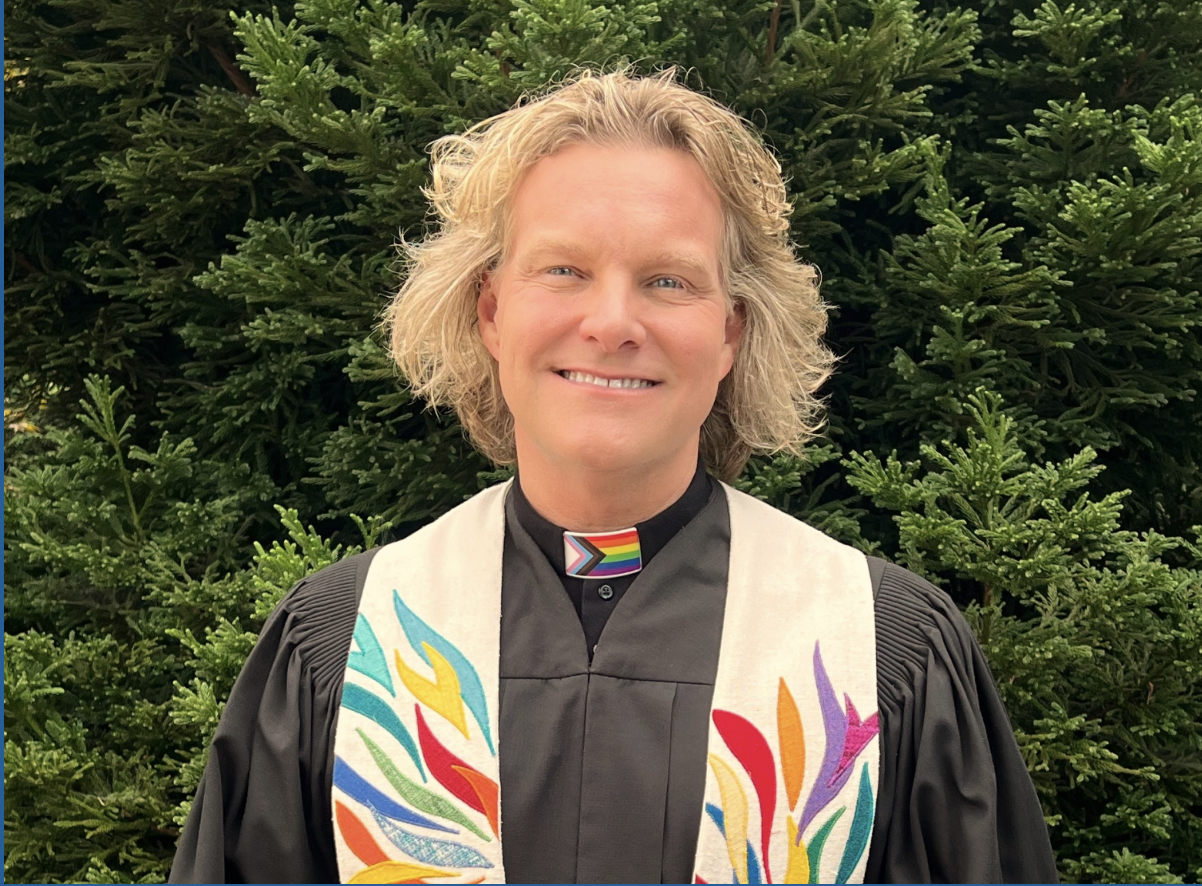
Pastor Brian
SPECIAL REQUEST FOR DONATIONS TO BENEVOLENCE FUND: Vanessa and her family recently had to move from their home, and during the move someone she had hired to help with furniture stole much of their belongings. They are now working to recover from this loss. If you are able, please consider helping a member of our community with whatever support you can during this difficult time.

New Day continues its mission to become a "church beyond the walls" with a broad range of activities to build community and several ways to grow in your faith and spirituality over the rest of this month.
Upcoming Events
- Monthly Service Project: Friday, March 20, 2026, 7:00 p.m. Twisted Trivia benefitting Piedmont Cares. 1881 Event Hall, Spartanburg, SC.
- Community Event: Thursday, March 26, 2026. Greenville Gay Men's Chorus hosts the Washington D.C. Gay Men's Chorus. 7:30 p.m. - 9:00 p.m. First Baptist Greenville. Free.
- Community Event: Sunday, March 29, 2026. Queer Wellness Center hosts a Dance-a-Thon at the Radio Room. Doors open at 6:00 p.m. with dance events starting at 6:30 p.m. $20 admission.
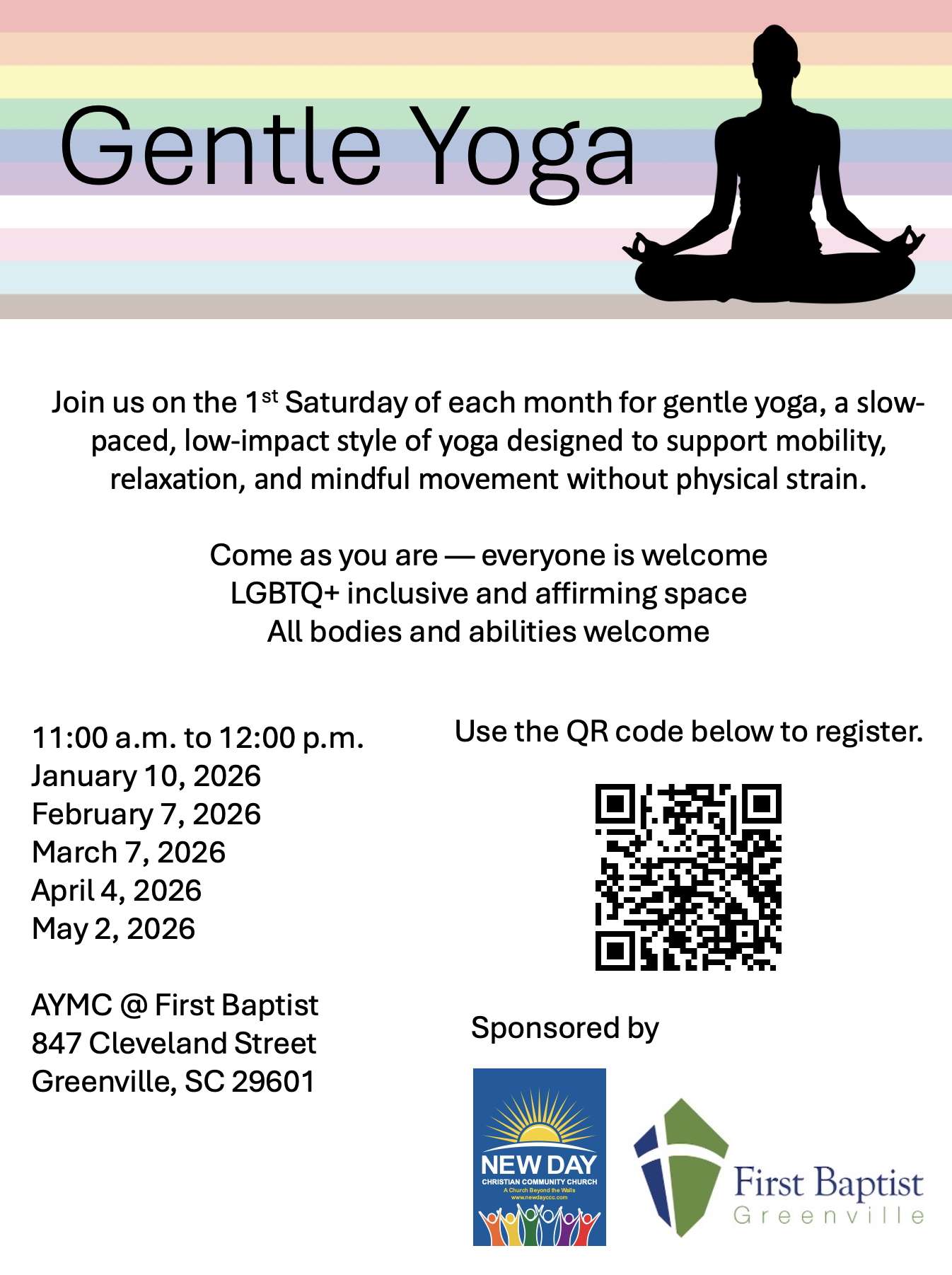
- Gentle Yoga: Saturday, April 4, 2026, at 11:00 a.m. at the AYMC at First Baptist Greenville.
- EASTER SUNDAY Worship Service: Sunday, April 5, 2026. Worship Service at 10:30 a.m. at Pastor Brian and Scott’s home, 1 Clock Tower Court, Belton, SC 29627. Lunch to follow. Bring a side dish.
- Monthly Social Event: Friday, April 10 to Sunday, April 12. Camping near Rosman, NC. Please contact Scott to sign up.
- Bible Study: Sunday, April, 19, 2026, at 10:30 a.m. Place to be determined.
- Monthly Service Project: Sunday, April 26, 9:00 a.m. – 12:00 p.m. Project Host soup kitchen. Contact Pastor Brian to sign up.
If you'd like to add anything for next weeks' community prayer, please contact Pastor Brian at pastor@newdayccc.com.
- Prayers for New Day as we search for a new worship home.
- PRAISES that Sarah is enjoying her new job and doing well.
- PRAISES for positive developments in Andrea's relationship with her family
- Prayers for Pastor Teresa following her surgery to remove cancerous growths.
- Prayers for Jamie who is recovering from having work done on her knee. Prayers that her pain levels will subside.
- PRAISES that Jason's disability was approved. Prayers as he considers next steps.
- Prayers for Andrea, Beth, Pastor Brian, and others who have unspoken requests this week.
Please support the work of the church by donating your time, talent, and tithe.
As we embrace new opportunities in 2026, your support is more vital than ever. Your generosity fuels our mission to serve the LGBTQ community, provide a welcoming space for worship, and grow into all God calls us to be. Every gift, no matter the size, helps us continue creating a space of love, connection, and hope. Thank you for being part of this journey—your contributions truly make a difference.
3/13/26
Tithe Income: $5,995
Other Income: $1,073
Interest Earned: $991
Expenses: $8,351
Net Loss: -$292
Click the link below to give through our Flocknote portal or donate through Zelle to treasurer@newdayccc.com.
New Day Christian Community Church
MEETING LOCATION - OTHER LANDS
March 15, 2026 Worship Service
731 Rutherford Road, Greenville, SC 29609
New Day Christian Community Church exists to provide a diverse, open, and affirming Christian community to all who desire a discipleship walk with Jesus Christ by offering challenging worship experiences, mission-based service opportunities, and Biblical learning so that we are empowered to reach out to others, introduce them to the love and strength of the beloved community, and invite them to join the faith journey of discipleship.