🌟February Theme: Anchored🌟
🌟Worship, Sunday, February 15, 2026🌟
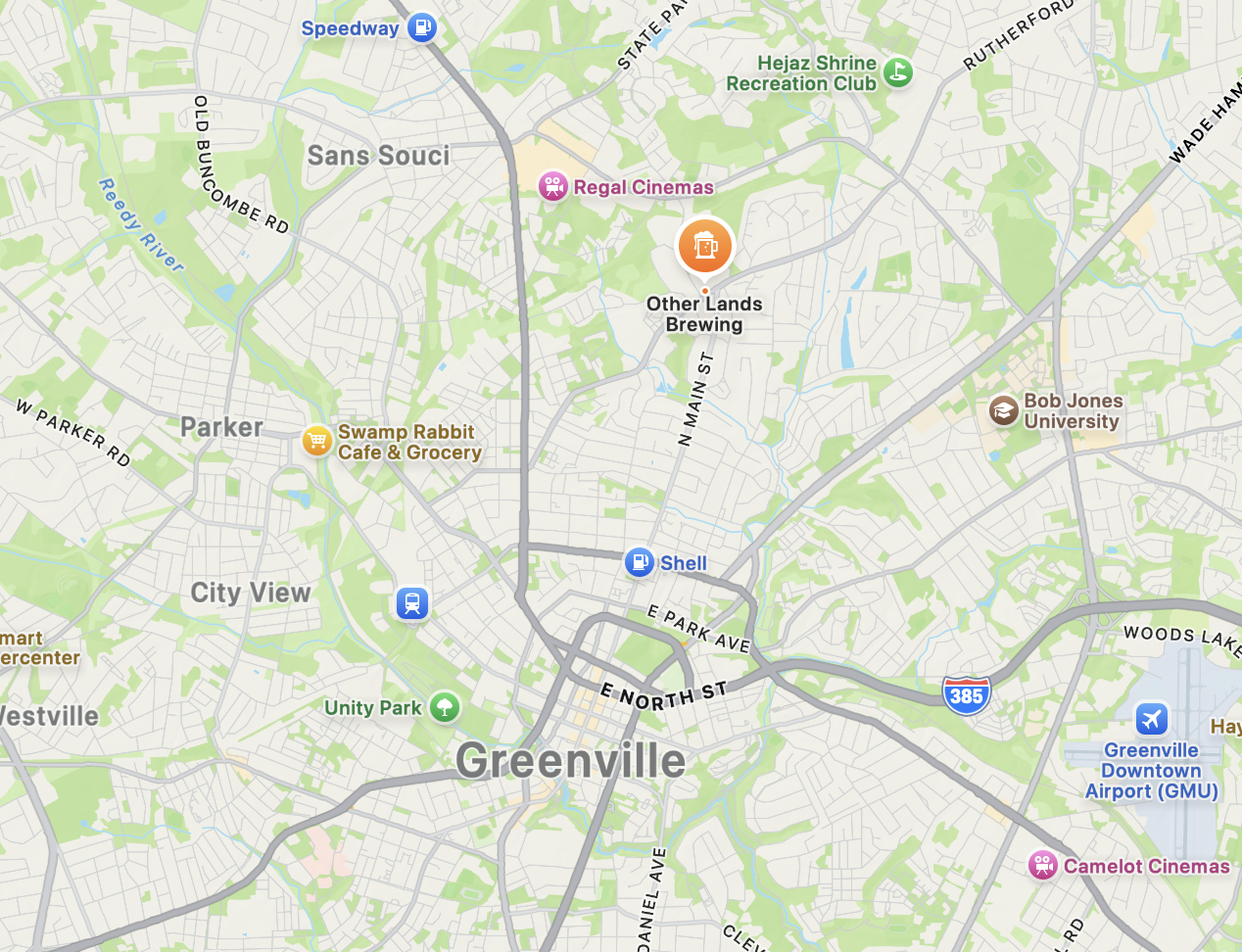
🌟10:30 a.m. at Other Lands🌟
This Sunday we continue our reflection on what anchors our faith. Anchors steady us in storms. They keep us from drifting when the waters rise. But sometimes, anchors get stuck in the mud and muck, and they leave us stuck. Part of spiritual maturity is learning when faithfulness means cutting anchor.
As we honor Black History Month in our Divine Discoveries segment, Pastor Brian will feature Black theologians who wrestled with this question in the most concrete way imaginable. They lived in a world where Christianity was preached on Sunday and oppression was practiced on Monday. They had to ask whether the faith they inherited was truly the faith of Jesus or a faith that had become tied to power. They refused to accept a religion that comforted the comfortable while asking the suffering to wait. Instead, they searched Scripture again and again for the God who hears cries, breaks chains, and stands with the wounded.
Pastor Brian will invite us to reflect on areas where we are stuck. Together we will ask what anchors our life with God and what may be keeping us from moving toward love.
Come ready not just to listen, but to discern what in our faith needs to be held tightly and what we may need the courage to release.
🌟Congregational Meeting🌟
🌟Sunday, February 15, 2026🌟
🌟Following Worship Service🌟
Join us after worship for a special congregational meeting to vote on the 2026 budget.
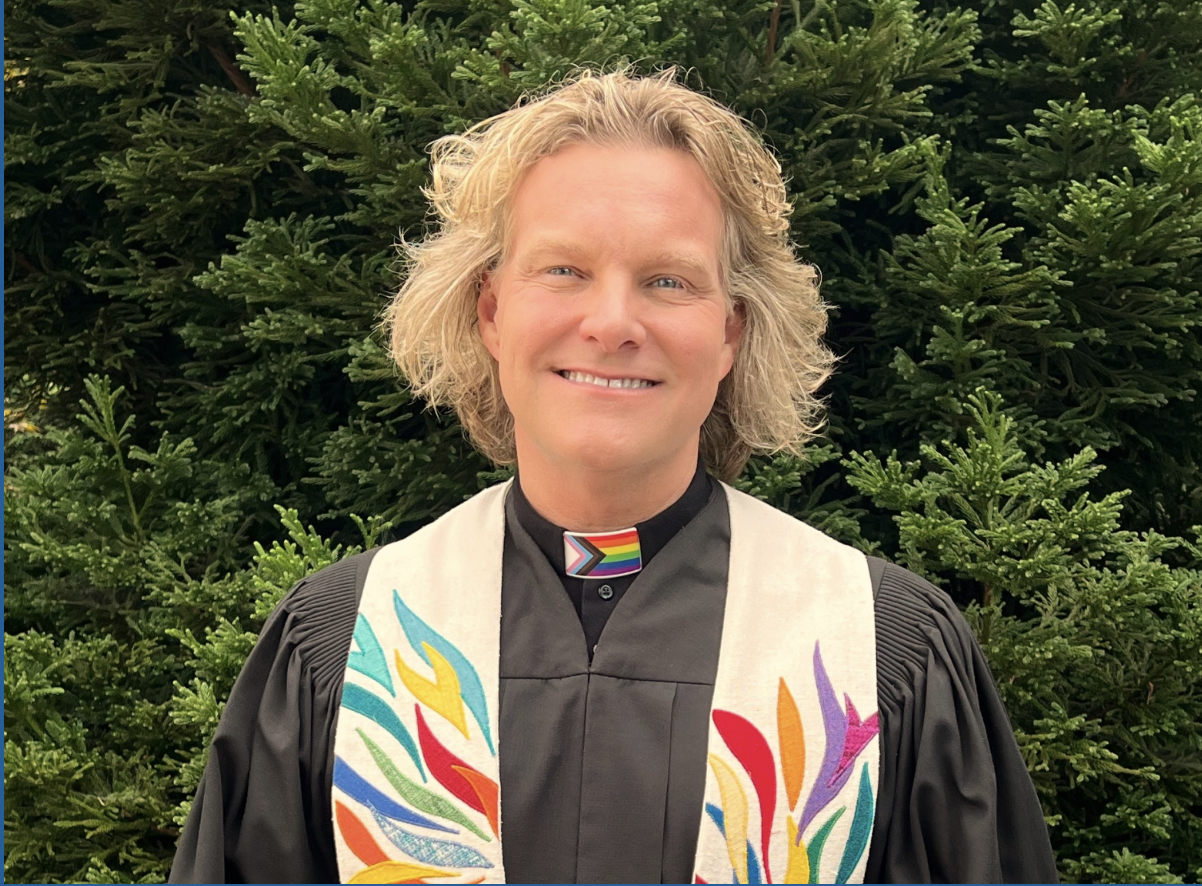
Dear Beloved Community,
REFLECTIONS ON CHRISTIANITY AND POWER STRUCTURES
One of the central questions running through Christian history is simple but uncomfortable: does Christianity stand with power, or does it stand with those pushed to the edges by power?
Unfortunately, in our modern political culture, we often see those who claim the name Christian more concerned with appeasing the powerful than standing beside the vulnerable. Yet the roots of the Christian faith did not sprout from fields of power. They grew in the soil of a people who remembered slavery and liberation and were watered by the tears of prophets who spoke against kings. Jesus lived and taught in that same ground, among the poor, the sick, and the socially unwanted. The earliest Christians were not the cultural center. They were the margins.
But history shifted. As Christianity moved from persecuted minority to official religion of empire, the church often began to protect stability more than people. The same Scriptures were read, but now from the seat of authority rather than from the underside of society. A faith once planted in hard earth learned to grow comfortably in imperial gardens, and the fruit changed with the soil.
Black liberation theologians have forced the modern church to face this tension honestly. Writing from the experience of slavery, segregation, and racial violence, they ask: When Christianity blesses oppression, does it remain faithful to Christ at all?
Black churches became fertile ground for the Civil Rights Movement, and its leaders called on white pastors to join them in their fight against injustice. The response was often silence, with many arguing that churches need to stay out of politics and focus only on saving souls. Black theologians remind us that the gospel never has been and never can be apolitical. A faith that ignores suffering, excuses injustice, or asks the harmed to be patient while protecting the powerful has taken the side of empire. The Christ revealed in Scripture stood in solidarity with the oppressed. Jesus was crucified for standing against empire and power structures.
A century before black theologians embraced liberation as the hallmark of their faith, abolitionist Frederick Douglass identified the core conflict that existed and continues to exist in American Christianity. He spoke of the Christianity of Christ as pure, peaceable, impartial, and a defender of the oppressed. This faith is centered on love, redemption, and liberation. Douglass contrasted this with the Christianity of the Land, which he called a “climax of all misnomers,” a “boldest of all frauds,” and a “grossest of all libels”. He condemned this type of Christianity in the sharpest of words. He defined the Christianity of the Land as a slaveholding, women-whipping, cradle-plundering religion practiced by hypocrites who use faith to justify cruelty.
Today, we might define the Christianity of the Land as a stranger-rejecting, trans-scapegoating religion grown in the soil of fear and watered by the tears of the oppressed.
Perhaps my gardening metaphor here is overgrown and needs some trimming, but Jesus taught us how to judge faith: look at the fruit. When fear, exclusion, and harm grow from it, we already have our answer. The Christianity of the Land is not bearing good fruit.
And a tree that bears bad fruit is not healed by pruning. It must be pulled up by the roots and replaced with a tree rooted in the Christianity of Christ.
Blessings,
Pastor Brian

New Day continues its mission to become a "church beyond the walls" with a broad range of activities to build community and several ways to grow in your faith and spirituality over the rest of this month.
Upcoming Events
- Worship Service: Sunday, February 15, 2026. Worship Service at 10:30 a.m. at Other Lands.
- Community Service Project: Saturday, February 28, 2026, 10:00 a.m. - 12:00 p.m. Festival of Queer Books at Trinity Lutheran. New Day will have a table at this event where we will hand out LGBTQ-themed books for free to those attending. If you would like to volunteer at this event, please contact Pastor Brian.
- Bible Study: Sunday, March 1, 2026, at 10:30 a.m. at Other Lands.
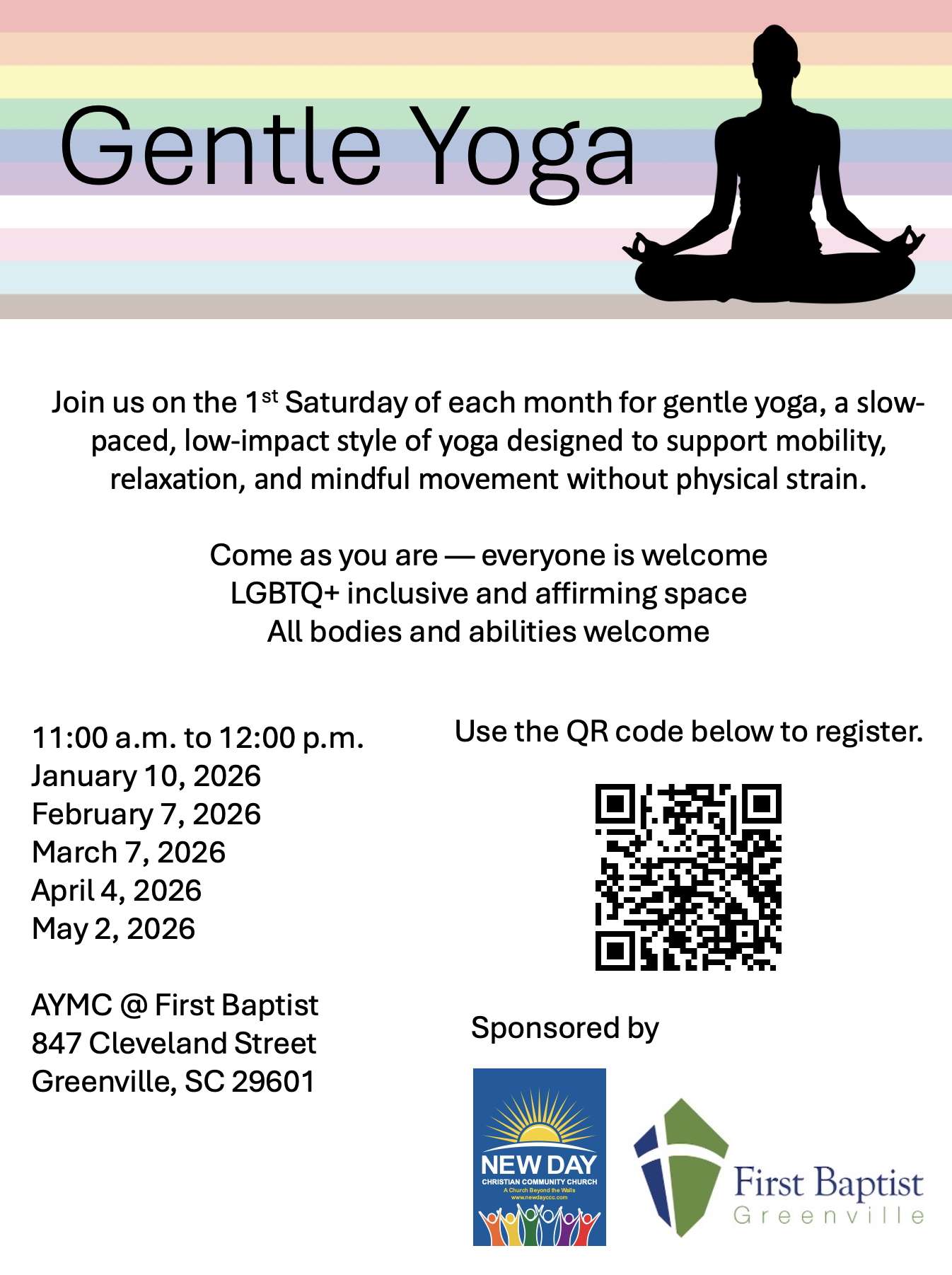
- Gentle Yoga: Saturday, March 7, 2026 at 11:00 a.m. at the AYMC at First Baptist Greenville.
- Worship Service: Sunday, March 15, 2026. Worship Service at 10:30 a.m. at Other Lands or alternate location to be determined.
- Community Event: Thursday, March 26, 2026. Greenville Gay Men's Chorus hosts the Washington D.C. Gay Men's Chorus. 7:30 p.m. - 9:00 p.m. First Baptist Greenville. Free.
- Community Event: Sunday, March 29, 2026. Queer Wellness Center hosts a Dance-a-Thon at the Radio Room. Doors open at 6:00 p.m. with dance events starting at 6:30 p.m. $20 admission.
If you'd like to add anything for next weeks' community prayer, please contact Pastor Brian at pastor@newdayccc.com.
- Prayers for New Day as we search for a new worship home.
- Prayers for Sarah as she honors the anniversary of her mother's passing.
- PRAISES that Scott is feeling a little better.
- Prayers for Pastor Teresa whose cancer has returned.
- PRAISES that Tracy's aunt woke up from a coma and has good early indications of recovery.
- Prayers for Tracy's friend Tamra who is recovering from knee surgery.
- Prayers for Jamie who is having a shot in her knee on Tuesday.
- Prayers for traveling mercies for Pastor Brian, Scott, and LJ.
- Prayers for Gary's mother whose cancer has metastasized.
- Prayers for Jason as he seeks to move back to California.
- Prayers for Pastor Brian, Andrea, and Sarah, and others who have unspoken requests this week.

Please support the work of the church by donating your time, talent, and tithe.
As we embrace new opportunities in 2025, your support is more vital than ever. Your generosity fuels our mission to serve the LGBTQ community, provide a welcoming space for worship, and grow into all God calls us to be. Every gift, no matter the size, helps us continue creating a space of love, connection, and hope. Thank you for being part of this journey—your contributions truly make a difference.
As of 2/12/26
Tithe Income: $2,685
Other Income: $1,073
Interest Earned: $825
Expenses: $4,144
Net: $439
Click the link below to give through our Flocknote portal or donate through Zelle to treasurer@newdayccc.com.
New Day Christian Community Church
MEETING LOCATION - OTHER LANDS
February 15, 2026 Worship Service and March 1, 2026 Bible Study
Future services TBD
731 Rutherford Road, Greenville, SC 29609
New Day Christian Community Church exists to provide a diverse, open, and affirming Christian community to all who desire a discipleship walk with Jesus Christ by offering challenging worship experiences, mission-based service opportunities, and Biblical learning so that we are empowered to reach out to others, introduce them to the love and strength of the beloved community, and invite them to join the faith journey of discipleship.